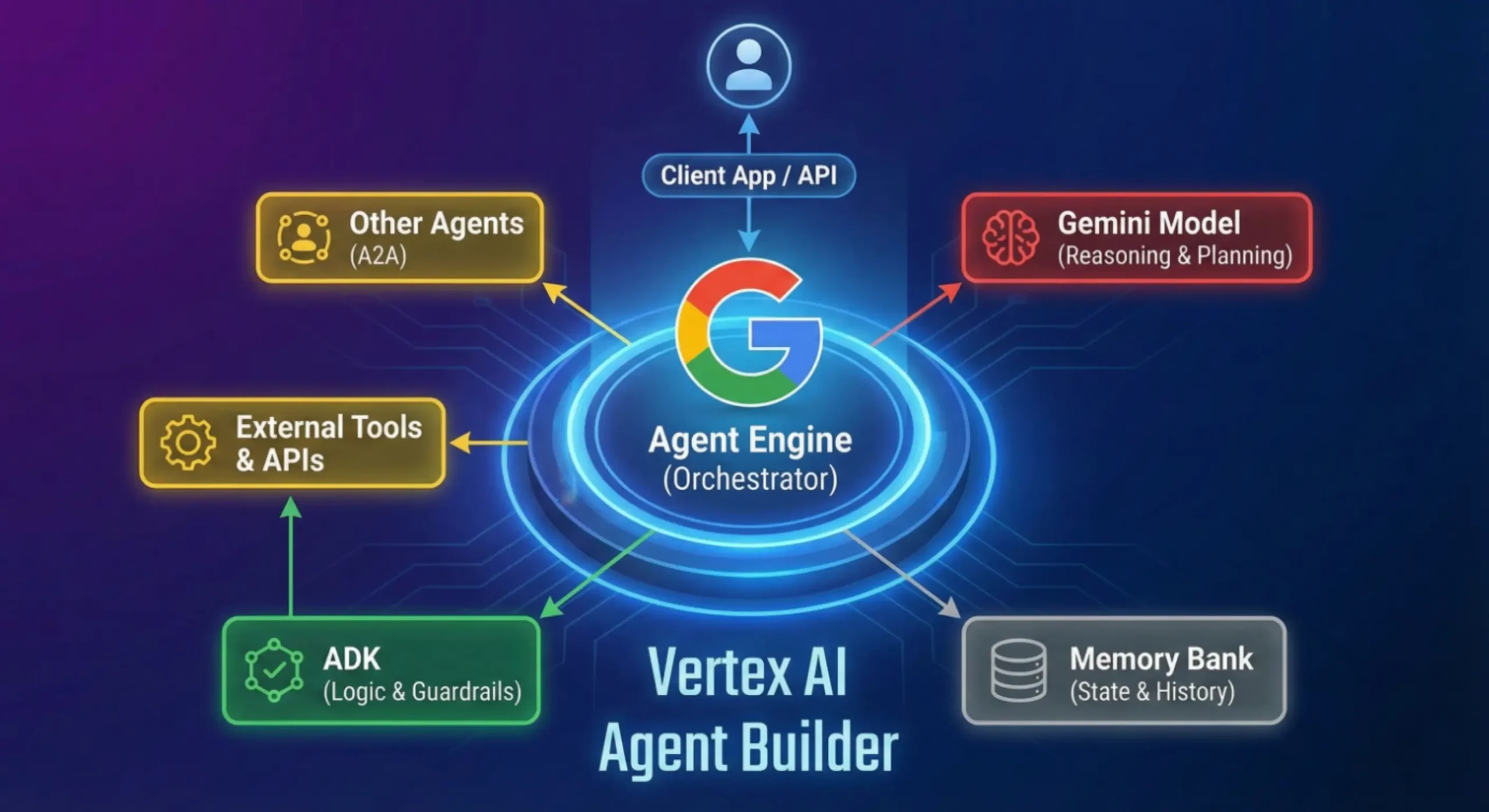
Isometric illustration of Vertex AI Agent Builder architecture with Google logo

Overview

Vertex AI Agent Builder is Google’s comprehensive platform for building, deploying, and governing enterprise-grade AI agents. It unifies a managed serverless runtime (Agent Engine), a code-first framework (Agent Development Kit), and the Agent2Agent protocol to create scalable systems where multiple agents can collaborate. It is powered by the reasoning capabilities of Gemini 3.

Provider: Google Cloud

Agentic ID: google-vertex-agent-builder

Release: 2025-11-20

Status: GA

Architecture

Summary

The architecture utilizes the Agent Development Kit (ADK) for defining agent logic, which is deployed to the Vertex AI Agent Engine. It uses Gemini 3 for high-level reasoning and planning. State is managed via Sessions and Memory Stores (Memory Bank). Agents communicate externally or with other agents using the Agent2Agent (A2A) Protocol.
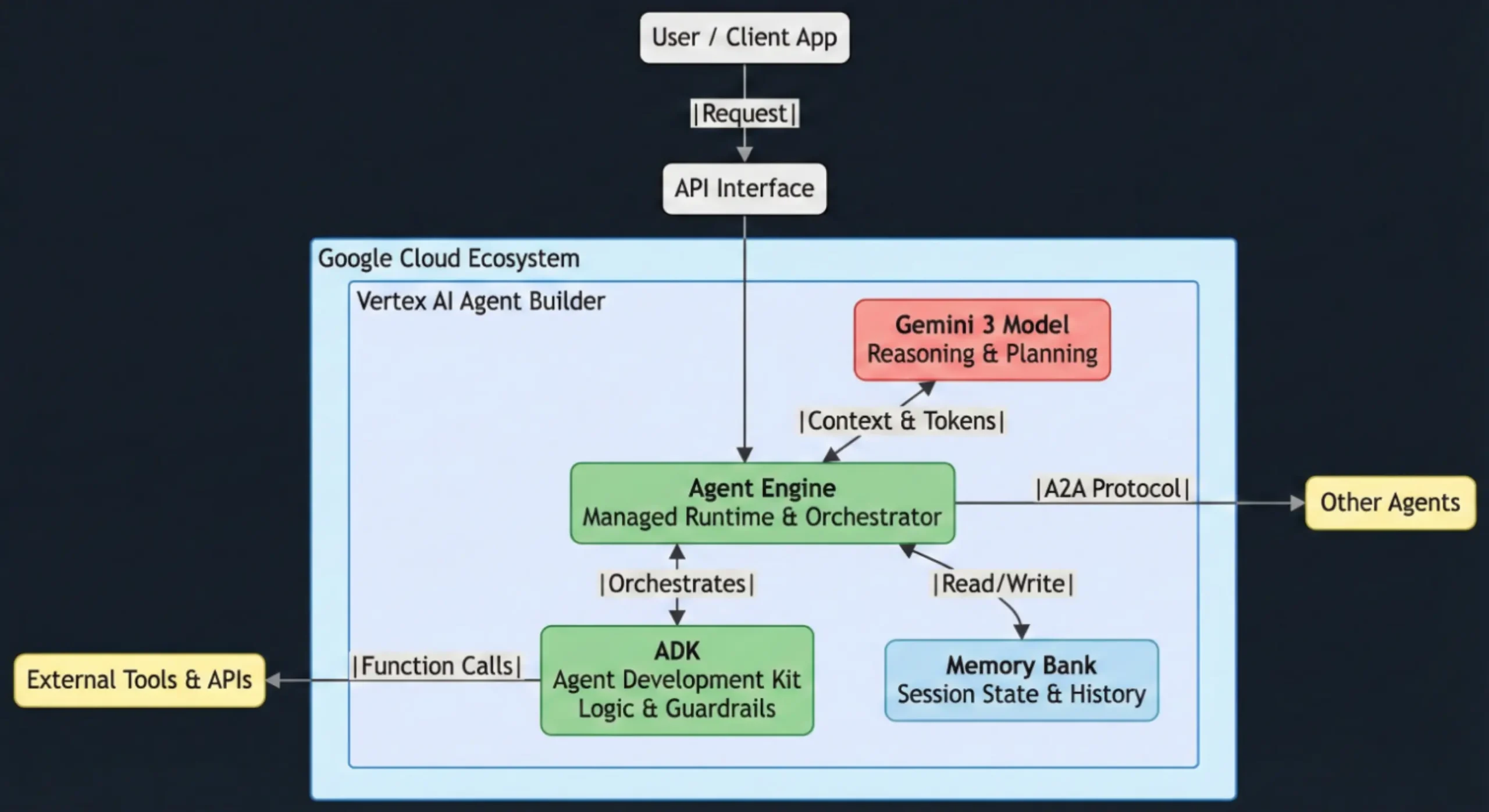
Vertex AI Agent Architecture: Flow from User to Agent Engine, utilizing ADK for logic and Gemini for reasoning.
v2025.11

Supported Models

🤖 Gemini 3 Pro

🤖 Gemini 2.5 Flash

Capabilities & Deployment Modes

Agent Capabilities: Tool Use, Planning, Memory, Safety, Evaluation, Guardrails, Monitoring

Deployment Modes: Cloud, Hybrid

Key Features

🟢 Agent Engine: A serverless managed runtime that handles auto-scaling, state management, and reasoning loops.

🟢 Agent Development Kit (ADK): A Python/Java framework for defining agent logic with deterministic guardrails.

🟢 Agent2Agent (A2A) Protocol: Standardized interoperability allowing agents to discover and communicate with one another.

🟢 Memory Bank: Persistent state management allowing agents to remember user preferences and context across sessions.

Feature Details

Agent Engine Memory Bank

Status: Public Preview

Announced: 2025-10-06

Description: Persistent memory storage for agents.

Agent2Agent Protocol

Status: GA

Announced: 2025-11-06

Description: Inter-agent communication standard.

Integration Methods

REST API

Python SDK

LangChain Integration