
Speech-to-Reality System Transforms Object Creation
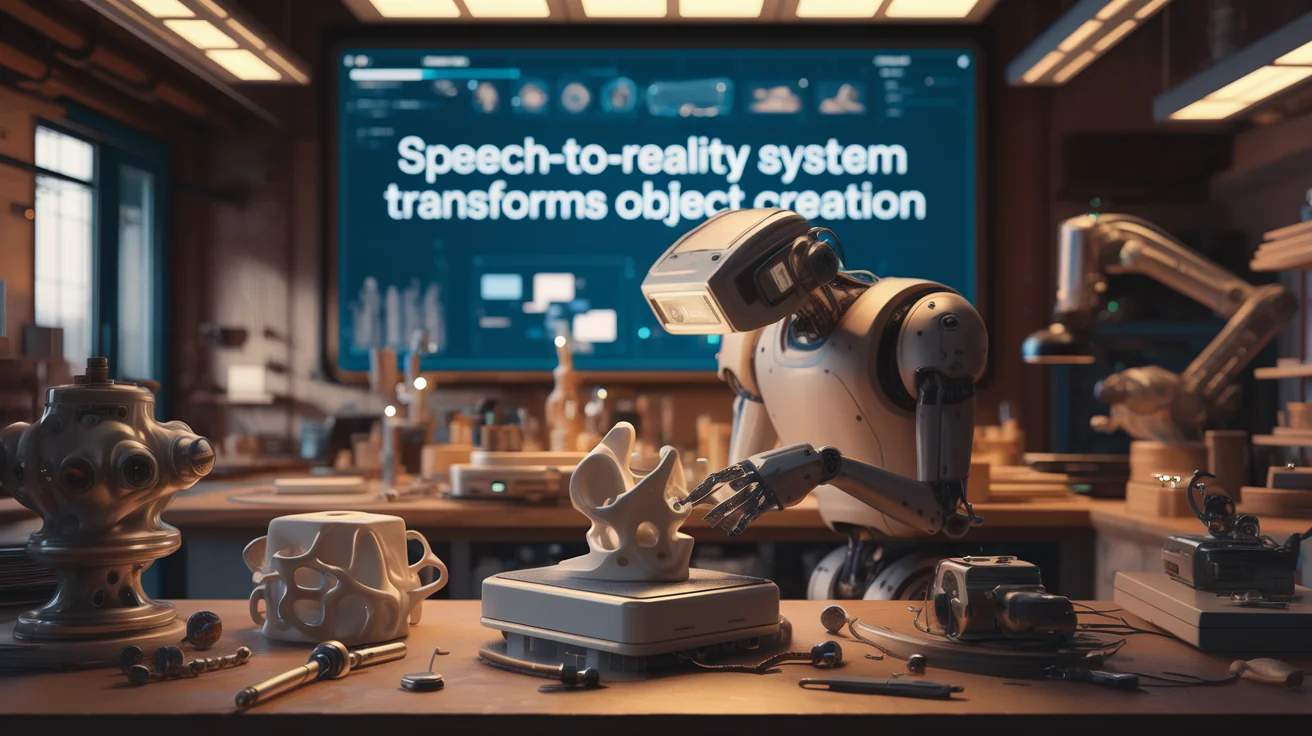
Generative AI and robotics are advancing rapidly, moving us closer to a future where asking for an object can result in its creation within minutes. Researchers from MIT have developed a transformative system referred to as the speech-to-reality system. This innovative AI-driven workflow allows users to input requests to a robotic arm, essentially enabling them to ‘speak objects into existence’ and create items such as furniture in as little as five minutes.
The speech-to-reality system employs a robotic arm that listens to verbal commands. For instance, when a user says, “I want a simple stool,” the system springs into action, constructing the requested object using modular components. So far, the team has successfully created not only stools but also shelves, chairs, small tables, and even decorative pieces, like a dog statue.
Alexander Htet Kyaw, an MIT graduate student involved in the project, noted, “We are merging natural language processing, 3D generative AI, and robotic assembly, integrating these rapid advancements in ways previously unexplored to create physical items from simple spoken prompts. This provides an unprecedented accessibility to design and manufacturing processes.” This approach represents a significant departure from conventional methods that require expertise in 3D modeling or robotic programming, making the technology user-friendly.
The inception of this project occurred during a course taught by Professor Neil Gershenfeld, known as “How to Make Almost Anything.” Kyaw, who is pursuing studies in the School of Architecture and Electrical Engineering and Computer Science, built this ground-breaking system under Gershenfeld’s guidance at the MIT Center for Bits and Atoms. Collaborators included graduate students Se Hwan Jeon and Miana Smith of different MIT departments.
The operational framework of the speech-to-reality system begins with speech recognition technology that interprets the user’s spoken input through a large language model. This is followed by 3D generative AI which digitally constructs the object’s mesh representation. Subsequently, a voxelization algorithm deconstructs the 3D mesh into assembly components tailored to the task.
The system excels in optimizing the design for real-world fabrication by considering physical constraints like the structure’s connectivity, overhangs, and the total number of components involved. It then formulates an executable assembly sequence alongside automated path planning for the robotic arm. This differs from traditional 3D printing, where fabrication can take hours or days, thereby indicating a marked efficiency in production speed.
Kyaw’s vision is ambitious; he imagines scenarios where a simple verbal request like, “I want a chair,” results in a tangible chair appearing within minutes. Immediate enhancements to the system are also on the horizon, particularly improving the weight-bearing capabilities of the furniture by enhancing the connection techniques from magnets to sturdier alternatives.
Additionally, the implementation of modular components aims to minimize material waste, showcasing a commitment to sustainability through disassembly and reassembly of units for a variety of needs, such as transforming a sofa into a bed.
Kyaw also plans to incorporate gesture recognition into the speech-to-reality system, creating versatile interaction modes that combine speech and movement. Drawing inspiration from iconic fictional technology, he hopes to democratize the manufacturing process, allowing individuals to produce objects rapidly and sustainably.
Reflecting on the project, he stated, “I aspire to a future where the essence of matter is within your control, allowing for the generation of reality on demand.” The team recently presented their paper titled “Speech to Reality: On-Demand Production using Natural Language, 3D Generative AI, and Discrete Robotic Assembly” at the Association for Computing Machinery Symposium on Computational Fabrication, signifying their contribution to cutting-edge applications of AI and robotics in modern design.